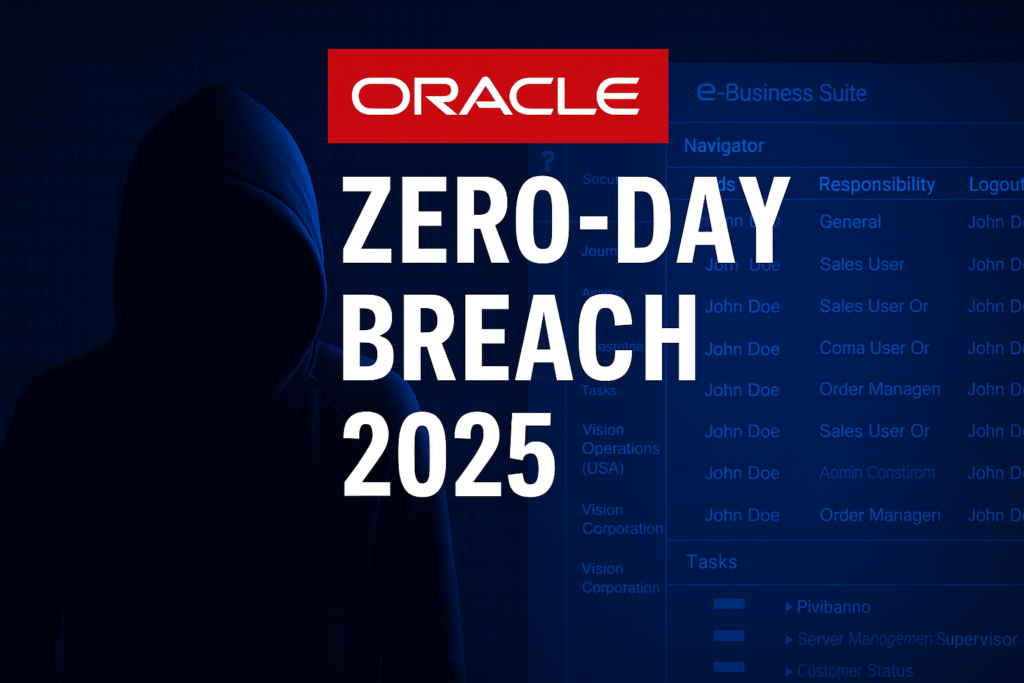
Security researchers have discovered that CL0P, one of the most notorious ransomware and extortion groups, is exploiting a zero-day vulnerability in Oracle’s E-Business Suite (EBS) to breach corporate networks around the world.
According to multiple threat intelligence sources, the attackers have already compromised dozens of organizations, using the vulnerability to gain unauthorized access to sensitive enterprise data and deploy ransomware payloads.
This marks yet another sophisticated supply-chain attack targeting critical enterprise software used by thousands of global businesses.
What Happened
Oracle’s E-Business Suite, used by major corporations for ERP, HR, and financial management, contains a previously unknown flaw that allowed unauthenticated remote access to internal applications.
The CL0P group reportedly identified and exploited this weakness before Oracle released any patch, making it a true zero-day exploit.
Once inside a network, attackers:
- Escalated privileges to admin-level access
- Exfiltrated sensitive business data
- Deployed ransomware payloads on connected servers
Researchers say the attacks began as early as late August 2025, with a noticeable spike in incidents reported in early October.
Who Is Behind the Attack
The CL0P group has a long history of high-impact ransomware and data extortion campaigns, often targeting corporate and government entities through software supply-chain vulnerabilities.
In 2023 and 2024, the group gained international notoriety for its mass exploitation of the MOVEit Transfer vulnerability, which compromised hundreds of organizations globally.
This new Oracle campaign shows CL0P’s continued evolution toward exploiting trusted enterprise applications rather than relying solely on phishing or brute-force intrusions.
How the Attack Works
Based on early analysis, the attack chain involves several key stages:
- Initial Access:
Exploiting an unpatched flaw in Oracle E-Business Suite’s web component, allowing remote code execution. - Privilege Escalation:
Once inside, the attackers move laterally across servers and elevate privileges through misconfigured Oracle database accounts. - Data Exfiltration:
Sensitive data — including HR records, invoices, and financial reports — is copied to external servers controlled by the attackers. - Ransomware Deployment:
After reconnaissance, the group encrypts critical systems and leaves ransom notes demanding cryptocurrency payments.
The technical details of the exploit have not yet been publicly disclosed, as Oracle is still conducting investigations and developing a fix.
Oracle’s Response
Oracle confirmed that it is aware of “a security issue under active investigation” and is working on an emergency update.
The company urged all customers running Oracle E-Business Suite 12.2 and earlier to:
- Immediately restrict internet exposure of EBS servers.
- Disable unnecessary external interfaces.
- Monitor network traffic for signs of exploitation.
- Apply security updates as soon as they become available.
Organizations using managed Oracle cloud services are reportedly less affected, as Oracle’s own security team has already implemented temporary mitigations.
The Broader Impact
Cybersecurity analysts warn that this incident could have widespread implications for supply-chain security, given the number of businesses relying on Oracle’s enterprise software.
EBS is deeply integrated with other systems — including Microsoft SQL, SAP connectors, and third-party APIs — which could expand the blast radius of a single breach.
Experts also note that ransomware gangs increasingly target business management and ERP platforms, viewing them as high-value assets capable of causing severe operational disruption.
Lessons for Security Teams
- Restrict Internet Exposure:
Never expose enterprise management tools like EBS, SAP, or SharePoint directly to the internet. - Segment ERP Networks:
Isolate enterprise software from critical production and administrative domains. - Monitor for Anomalous Behavior:
Look for unexpected Oracle processes, large data exports, or unauthorized admin logins. - Patch Management:
Maintain a rapid patching policy and subscribe to vendor advisories. - Incident Response Preparedness:
Review ransomware response plans and backup strategies to ensure business continuity.
Expert Commentary
According to cybersecurity researcher Daniel Ross from CyberWatch Labs,
“This incident shows the danger of complex, interconnected ERP systems. When attackers find one flaw in an enterprise platform like Oracle E-Business Suite, it can cascade across the entire network. The lesson is simple: visibility, segmentation, and constant patching are non-negotiable.”